The Taíno Presence in Modern Puerto Rico: What Survived the Conquest
By William Rivera, Will Boricua
For centuries, the history books told a simple story about the Taíno people of Puerto Rico: they arrived, they met the Spanish, and they vanished. Extinct. Gone. A closed chapter. That story is wrong. The Taíno did not disappear. They survived — in the blood of their descendants, in the words Puerto Ricans speak every day, in the food on the table, in the names of towns and rivers, and in a living cultural revival that grows stronger every year. This is what survived the conquest.
The Myth of Extinction
The claim that the Taíno went extinct took hold early. Spanish chroniclers, writing in the decades after 1493, described a population collapse. Disease, forced labor, and violence devastated Indigenous communities across the Caribbean. By the mid-1500s, the Taíno as a distinct political society — with its caciques, its villages, its batey ball courts — had been broken apart. Colonial officials recorded the island's Indigenous population as gone, absorbed, or replaced.
But "broken apart" is not the same as "gone." The Taíno did not vanish. They adapted. They intermarried with Africans and Europeans. They moved into the mountains, into the interior, into the margins of colonial society where the record-keepers stopped looking. Their children and grandchildren carried Taíno ancestry forward, often without the paperwork or the labels that historians later demanded as proof. The extinction story was written by people who stopped counting.
What the DNA Says
The strongest evidence that the Taíno survived comes from the science of genetics. In 2018, researchers published the complete genome of a woman who lived in the Bahamas about 1,000 years ago, before European contact. She was Lucayan — a Taíno-related people from Eleuthera in the Bahamas, not from Puerto Rico itself. When scientists compared her ancient DNA to the DNA of modern Puerto Ricans, they found something remarkable: Native American genetic components, matching her lineage, are present in living Puerto Ricans today.
The study, published in the Proceedings of the National Academy of Sciences (Schroeder et al., 2018), showed that the Indigenous ancestry of the Caribbean did not end with the conquest. It continued. Modern Puerto Ricans carry a measurable Taíno genetic inheritance — published estimates put Indigenous ancestry at roughly 10–15% on average, with wide variation from person to person. The exact percentage varies, but the pattern is clear and consistent: the Taíno are ancestors of the modern Puerto Rican people.
This was not a surprise to many Puerto Ricans. Families across the island have long told stories of an Indigenous grandmother, a Taíno great-grandfather, a relative from the mountains with features the family recognized as Indigenous. The DNA simply confirmed what oral history had preserved. The extinction story was a colonial fiction. The genes tell the truth.
The Words We Still Speak
You do not need a DNA test to find the Taíno. You can hear them every day, in the ordinary words of Puerto Rican Spanish. The Taíno language gave Spanish — and through Spanish, English — a set of words so common that most speakers never stop to think about where they came from.
Huracán. The word for hurricane comes from Juracán, the Taíno god of chaos and the storm. When Puerto Ricans talk about hurricane season, they are speaking a Taíno god's name. Canoa. The canoe — the dugout boat the Taíno used to travel between islands — gave English the word canoe. Hamaca. The hammock, woven from cotton and hung between trees, was a Taíno invention that the Spanish adopted and the whole world now uses. Barbacoa. The barbecue — the raised wooden grill for slow-cooking meat over fire — comes from the Taíno barbacoa.
The list goes on. Yuca. Maíz. Tabaco. Guava. Papaya. Iguana. Caimán. Manatí. These are Taíno words, embedded so deeply in the language that they feel like they were always there. They were. The Taíno language did not die. It became part of the language Puerto Ricans speak. Every time a Puerto Rican says "hamaca" or "huracán," the Taíno language is still alive.
The Food on the Table
Taíno survival is also on the plate. The Taíno were farmers, and the crops they cultivated are still the foundation of Puerto Rican food. Yuca — cassava — was the most important Taíno crop, and it remains central to the island's cooking. Casabe, the flatbread made from grated yuca, is one of the oldest foods in the Caribbean, and it is still made and eaten in Puerto Rico today.
The Taíno also grew sweet potatoes, yautía, maize, and peppers. They fished the reefs and rivers. They hunted the jutía, a small rodent that was a source of meat. They cooked on the barbacoa, the raised grill that gave the world barbecue. The methods, the ingredients, the flavors — much of what people think of as traditional Puerto Rican food has Taíno roots underneath the Spanish and African influences that later joined it. Learn more in our guide to Taíno food and agriculture.
When a Puerto Rican family grates yuca for casabe, or slow-cooks meat over a fire, or plants a garden with yautía and sweet potatoes, they are practicing agriculture and cooking that the Taíno developed over centuries. The food did not disappear with the conquest. It was carried forward, meal by meal, generation by generation.
The Names on the Land
The Taíno are also written into the map. Borikén — the Taíno name for the island itself — is still used with pride by Puerto Ricans who want to honor the island's first name. Borinquen, a variation, appears in the island's anthem and in everyday speech. The name Puerto Rico is Spanish, but the island's Taíno name never left.
Town and river names across the island carry Taíno words. Utuado. Arecibo. Mayagüez. Guaynabo. Caguas. Bayamón. Loíza. These names come from Taíno caciques, Taíno words for places, Taíno descriptions of the land. The Spanish kept many of them because they were already the names people used. The map of Puerto Rico is, in large part, a Taíno map.
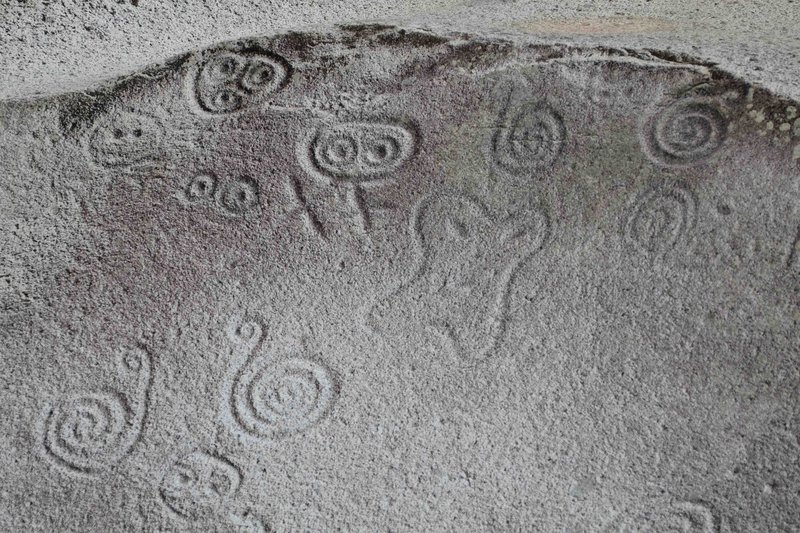
Taíno petroglyphs — stone carvings that still stand where the Taíno left them. See our guide to Taíno petroglyphs.
The landscape itself holds Taíno presence. The petroglyphs — stone carvings of faces, spirals, and figures — still stand at sites like Tibes in Ponce and Cueva del Puente in Loíza. The batey ball courts, where the Taíno played their ceremonial ball game, are still visible in the ground. The cemíes — the three-pointed stone figures that represented the Taíno gods — are still found in the earth. The land remembers, even when the history books forgot.
The Revival
In recent decades, something remarkable has happened: Puerto Ricans have begun to reclaim their Taíno identity openly. The Taíno revival movement — sometimes called the Taíno resurgence — is a living, growing community of people who identify as Taíno, who study the language, who practice the traditions, who teach their children the stories and the words.
This is not a reenactment. It is a reconnection. Taíno groups across Puerto Rico and the diaspora hold ceremonies, teach the language, carve petroglyphs, make casabe, and pass the knowledge to the next generation. They draw on the archaeological record, on the chroniclers' accounts, on the DNA evidence, and on the oral traditions that families preserved in the mountains and the countryside.
The revival is also a correction. For too long, the story was that the Taíno were gone and Puerto Rican identity was only Spanish and African. The revival says: no. The Taíno are part of who we are. They are in our blood, our language, our food, our place names, and our culture. To be Puerto Rican is, in part, to be Taíno.
Taíno Society: How They Lived
Before the conquest, the Taíno built a sophisticated society across Borikén and the wider Caribbean. They lived in villages called yucayeques, organized around a central plaza with a batey — the ball court where the ceremonial ball game was played. The batey was not just a playing field. It was the heart of the village, a place for ceremony, for settling disputes, for bringing communities together.
Each village was led by a cacique, a chief whose authority came from lineage and from the respect of the people. The cacique's house, the caney, was the largest in the village, and the cacique served as both a political leader and a spiritual intermediary. Below the cacique were the nitainos, the nobles and advisors, and then the common people who farmed, fished, built canoes, and wove cotton. It was a structured society, with clear roles, but also one where the cacique's power depended on generosity — a chief who did not share, who did not provide for the village, would lose the people's support.
The Taíno were skilled farmers. They developed the conuco, a raised mound system for growing yuca, sweet potatoes, and other crops. The conuco was an ingenious adaptation to the tropical climate and soil — it drained well in heavy rain, it kept the roots from rotting, and it could be worked year-round. The Taíno grew enough food to support large villages, to trade between islands, and to store surplus for hard times. They were not, as the old history books sometimes implied, simple people living hand to mouth. They were agricultural engineers who had learned to feed a civilization from the land.
They were also seafarers. The Taíno built large canoes, some big enough to carry dozens of people, and they traveled between islands regularly — trading, visiting relatives, forming alliances, and maintaining a connected Caribbean world. The sea was not a barrier. It was a road. The Taíno understood the currents, the winds, and the stars, and they used that knowledge to move across an island world that Europeans, when they arrived, barely understood.
Taíno Spirituality: The Cemí and the Cohoba
The Taíno spiritual world was centered on the cemí — a three-pointed stone or wooden figure that embodied a spirit, an ancestor, or a force of nature. The cemí was not a decoration. It was a living presence. Each cacique kept cemíes, and the people believed the cemí could speak, could advise, could protect, and could punish. The most powerful cemí belonged to the supreme god, Yucahú Bagua Maórocoti, the lord of cassava and the sea, the giver of life.
The Taíno communicated with the spirits through the cohoba ceremony. The behique — the priest and healer — would grind the seeds of the cohoba tree into a powder, inhale it through a forked tube, and enter a trance. In that state, the behique spoke with the cemí, asked for guidance, sought healing for the sick, and received visions. The ceremony was sacred, and it was taken seriously. The behique was not a magician. He was a mediator between the human world and the spirit world, and his role was essential to the community's wellbeing.
The areíto was the Taíno ceremony of song and dance — a way of preserving history, of teaching the young, of honoring the ancestors. In the areíto, the people gathered in the plaza, the drums sounded, and the singers recounted the stories of the village: the deeds of the caciques, the history of the people, the lessons of the past. The areíto was the Taíno history book, written in music and movement rather than ink. It was how a people without writing preserved their memory.
These spiritual practices did not vanish with the conquest. They went underground, into the mountains, into the private spaces where the colonial authorities could not reach. The cohoba ceremony, the reverence for the cemí, the songs of the areíto — elements of these survived in the folk practices, the healing traditions, and the oral stories of rural Puerto Rico. Today, in the Taíno revival, these practices are being reclaimed openly, studied, taught, and honored as the living spiritual heritage of the island's first people.
What Survived
So what survived the conquest? More than the history books admitted. The Taíno survived in the genes of their descendants. They survived in the words — huracán, hamaca, canoa, barbacoa — that Puerto Ricans speak without thinking. They survived in the food, in the yuca and the casabe and the cooking fire. They survived in the names of towns and rivers and the island itself. They survived in the petroglyphs and the ball courts and the cemíes in the ground. And now, in the revival, they survive in the open pride of people who claim their Taíno heritage and carry it forward.
The conquest tried to erase the Taíno. It failed. The Taíno are not a closed chapter. They are a living presence — in the blood, in the language, in the food, in the land, and in the people who still call themselves Boricua and mean it in the oldest sense of the word.
Will Boricua explores Taíno heritage, history, and the documents that tell the island's story.
Sources
Schroeder, H. et al. (2018). Origins and genetic legacies of the Caribbean indigenous peoples. Proceedings of the National Academy of Sciences.
La presencia taína en el Puerto Rico moderno: lo que sobrevivió a la conquista
Por William Rivera, Will Boricua
Durante siglos, los libros de historia contaron una historia simple sobre el pueblo taíno de Puerto Rico: llegaron, se encontraron con los españoles y desaparecieron. Extintos. Desaparecidos. Un capítulo cerrado. Esa historia está equivocada. Los taínos no desaparecieron. Sobrevivieron — en la sangre de sus descendientes, en las palabras que los puertorriqueños hablan todos los días, en la comida en la mesa, en los nombres de pueblos y ríos, y en un renacimiento cultural vivo que crece cada año. Esto es lo que sobrevivió a la conquista.
El mito de la extinción
La idea de que los taínos se extinguieron se arraigó temprano. Los cronistas españoles, escribiendo en las décadas después de 1493, describieron un colapso de la población. La enfermedad, el trabajo forzado y la violencia devastaron las comunidades indígenas en todo el Caribe. Para mediados del siglo XVI, los taínos como sociedad política distinta — con sus caciques, sus aldeas, sus canchas de batey — habían sido desarticulados. Los funcionarios coloniales registraron la población indígena de la isla como desaparecida, absorbida o reemplazada.
Pero "desarticulado" no es lo mismo que "desaparecido". Los taínos no se esfumaron. Se adaptaron. Se casaron con africanos y europeos. Se mudaron a las montañas, al interior, a los márgenes de la sociedad colonial donde los que llevaban los registros dejaron de buscar. Sus hijos y nietos llevaron la ascendencia taína adelante, muchas veces sin el papeleo ni las etiquetas que los historiadores después exigieron como prueba. La historia de la extinción fue escrita por gente que dejó de contar.
Lo que dice el ADN
La evidencia más fuerte de que los taínos sobrevivieron viene de la ciencia de la genética. En 2018, los investigadores publicaron el genoma completo de una mujer que vivió en las Bahamas hace unos 1,000 años, antes del contacto europeo. Era lucaya — un pueblo relacionado con los taínos, de Eleuthera en las Bahamas, no de Puerto Rico mismo. Cuando los científicos compararon su ADN antiguo con el ADN de los puertorriqueños modernos, encontraron algo notable: los componentes genéticos nativos americanos, que coinciden con su linaje, están presentes en los puertorriqueños vivos hoy.
El estudio, publicado en Proceedings of the National Academy of Sciences (Schroeder et al., 2018), mostró que la ascendencia indígena del Caribe no terminó con la conquista. Continuó. Los puertorriqueños modernos llevan una herencia genética taína medible — las estimaciones publicadas sitúan la ascendencia indígena en aproximadamente 10–15% en promedio, con amplia variación de persona a persona. El porcentaje exacto varía, pero el patrón es claro y consistente: los taínos son ancestros del pueblo puertorriqueño moderno.
Esto no fue una sorpresa para muchos puertorriqueños. Las familias en toda la isla han contado por mucho tiempo historias de una abuela indígena, un bisabuelo taíno, un pariente de las montañas con rasgos que la familia reconocía como indígenas. El ADN simplemente confirmó lo que la historia oral había preservado. La historia de la extinción era una ficción colonial. Los genes dicen la verdad.
Las palabras que todavía hablamos
No necesitas una prueba de ADN para encontrar a los taínos. Puedes escucharlos todos los días, en las palabras ordinarias del español puertorriqueño. La lengua taína le dio al español — y a través del español, al inglés — un conjunto de palabras tan comunes que la mayoría de los hablantes nunca se detiene a pensar de dónde vinieron.
Huracán. La palabra para el huracán viene de Juracán, el dios taíno del caos y la tormenta. Cuando los puertorriqueños hablan de la temporada de huracanes, están diciendo el nombre de un dios taíno. Canoa. La canoa — el bote excavado que los taínos usaban para viajar entre islas — le dio al inglés la palabra canoe. Hamaca. La hamaca, tejida de algodón y colgada entre árboles, fue una invención taína que los españoles adoptaron y que ahora usa todo el mundo. Barbacoa. La barbacoa — la parrilla elevada de madera para cocinar carne lentamente sobre el fuego — viene de la barbacoa taína.
La lista sigue. Yuca. Maíz. Tabaco. Guava. Papaya. Iguana. Caimán. Manatí. Estas son palabras taínas, incrustadas tan profundamente en el idioma que parece que siempre estuvieron allí. Lo estaban. La lengua taína no murió. Se convirtió en parte del idioma que hablan los puertorriqueños. Cada vez que un puertorriqueño dice "hamaca" o "huracán", la lengua taína sigue viva.
La comida en la mesa
La supervivencia taína también está en el plato. Los taínos eran agricultores, y los cultivos que cultivaban siguen siendo la base de la comida puertorriqueña. La yuca — la mandioca — era el cultivo taíno más importante, y sigue siendo central en la cocina de la isla. El casabe, el pan plano hecho de yuca rallada, es una de las comidas más antiguas del Caribe, y todavía se hace y se come en Puerto Rico hoy.
Los taínos también cultivaban batatas, yautía, maíz y ajíes. Pescaban en los arrecifes y ríos. Cazaban la jutía, un roedor pequeño que era fuente de carne. Cocinaban en la barbacoa, la parrilla elevada que le dio al mundo el barbecue. Los métodos, los ingredientes, los sabores — mucho de lo que la gente piensa como comida tradicional puertorriqueña tiene raíces taínas debajo de las influencias españolas y africanas que se unieron después. Aprende más en nuestra guía de comida y agricultura taína.
Cuando una familia puertorriqueña ralla yuca para el casabe, o cocina carne lentamente sobre el fuego, o siembra un huerto con yautía y batatas, está practicando la agricultura y la cocina que los taínos desarrollaron durante siglos. La comida no desapareció con la conquista. Se llevó adelante, comida tras comida, generación tras generación.
Los nombres en la tierra
Los taínos también están escritos en el mapa. Borikén — el nombre taíno de la isla misma — todavía se usa con orgullo por los puertorriqueños que quieren honrar el primer nombre de la isla. Borinquen, una variación, aparece en el himno de la isla y en el habla cotidiana. El nombre Puerto Rico es español, pero el nombre taíno de la isla nunca se fue.
Los nombres de pueblos y ríos en toda la isla llevan palabras taínas. Utuado. Arecibo. Mayagüez. Guaynabo. Caguas. Bayamón. Loíza. Estos nombres vienen de caciques taínos, de palabras taínas para lugares, de descripciones taínas de la tierra. Los españoles conservaron muchos de ellos porque ya eran los nombres que usaba la gente. El mapa de Puerto Rico es, en gran parte, un mapa taíno.
Petroglifos taínos — tallados en piedra que todavía se mantienen donde los taínos los dejaron. Mira nuestra guía de petroglifos taínos.
El paisaje mismo guarda la presencia taína. Los petroglifos — tallados en piedra de rostros, espirales y figuras — todavía se mantienen en sitios como Tibes en Ponce y Cueva del Puente en Loíza. Las canchas de batey, donde los taínos jugaban su juego ceremonial de pelota, todavía son visibles en la tierra. Los cemíes — las figuras de piedra de tres puntas que representaban a los dioses taínos — todavía se encuentran en la tierra. La tierra recuerda, aun cuando los libros de historia olvidaron.
El renacimiento
En las últimas décadas, algo notable ha sucedido: los puertorriqueños han comenzado a reclamar su identidad taína abiertamente. El movimiento de renacimiento taíno — a veces llamado el resurgimiento taíno — es una comunidad viva y creciente de personas que se identifican como taínas, que estudian el idioma, que practican las tradiciones, que enseñan a sus hijos las historias y las palabras.
Esto no es una recreación. Es una reconexión. Los grupos taínos en Puerto Rico y la diáspora celebran ceremonias, enseñan el idioma, tallan petroglifos, hacen casabe y transmiten el conocimiento a la próxima generación. Se basan en el registro arqueológico, en los relatos de los cronistas, en la evidencia del ADN y en las tradiciones orales que las familias preservaron en las montañas y el campo.
El renacimiento también es una corrección. Por demasiado tiempo, la historia fue que los taínos se habían ido y que la identidad puertorriqueña era solo española y africana. El renacimiento dice: no. Los taínos son parte de quienes somos. Están en nuestra sangre, nuestro idioma, nuestra comida, nuestros nombres de lugares y nuestra cultura. Ser puertorriqueño es, en parte, ser taíno.
La sociedad taína: cómo vivían
Antes de la conquista, los taínos construyeron una sociedad sofisticada en Borikén y el Caribe en general. Vivían en aldeas llamadas yucayeques, organizadas alrededor de una plaza central con un batey — la cancha de pelota donde se jugaba el juego ceremonial. El batey no era solo un campo de juego. Era el corazón de la aldea, un lugar para ceremonias, para resolver disputas, para reunir a las comunidades.
Cada aldea era dirigida por un cacique, un jefe cuya autoridad venía del linaje y del respeto de la gente. La casa del cacique, el caney, era la más grande de la aldea, y el cacique servía como líder político e intermediario espiritual. Debajo del cacique estaban los nitaínos, los nobles y consejeros, y luego la gente común que cultivaba, pescaba, construía canoas y tejía algodón. Era una sociedad estructurada, con roles claros, pero también una en la que el poder del cacique dependía de la generosidad — un jefe que no compartía, que no proveía para la aldea, perdería el apoyo de la gente.
Los taínos eran agricultores hábiles. Desarrollaron el conuco, un sistema de montículos elevados para cultivar yuca, batatas y otros cultivos. El conuco fue una adaptación ingeniosa al clima tropical y al suelo — drenaba bien con las lluvias fuertes, evitaba que las raíces se pudrieran y se podía trabajar todo el año. Los taínos cultivaban suficiente comida para mantener aldeas grandes, para comerciar entre islas y para almacenar excedentes para tiempos difíciles. No eran, como los viejos libros de historia a veces implicaban, gente simple viviendo al día. Eran ingenieros agrícolas que habían aprendido a alimentar una civilización desde la tierra.
También eran navegantes. Los taínos construían canoas grandes, algunas lo suficientemente grandes para llevar a decenas de personas, y viajaban entre islas regularmente — comerciando, visitando parientes, formando alianzas y manteniendo un mundo caribeño conectado. El mar no era una barrera. Era un camino. Los taínos entendían las corrientes, los vientos y las estrellas, y usaban ese conocimiento para moverse por un mundo de islas que los europeos, cuando llegaron, apenas entendían.
La espiritualidad taína: el cemí y la cohoba
El mundo espiritual taíno se centraba en el cemí — una figura de piedra o madera de tres puntas que encarnaba un espíritu, un ancestro o una fuerza de la naturaleza. El cemí no era una decoración. Era una presencia viva. Cada cacique guardaba cemíes, y la gente creía que el cemí podía hablar, aconsejar, proteger y castigar. El cemí más poderoso pertenecía al dios supremo, Yucahú Bagua Maórocoti, el señor de la yuca y el mar, el dador de vida.
Los taínos se comunicaban con los espíritus a través de la ceremonia de la cohoba. El behique — el sacerdote y sanador — molía las semillas del árbol de cohoba hasta hacerlas polvo, lo inhalaba por un tubo bifurcado y entraba en trance. En ese estado, el behique hablaba con el cemí, pedía guía, buscaba sanación para los enfermos y recibía visiones. La ceremonia era sagrada y se tomaba en serio. El behique no era un mago. Era un mediador entre el mundo humano y el mundo espiritual, y su papel era esencial para el bienestar de la comunidad.
El areíto era la ceremonia taína de canto y baile — una manera de preservar la historia, de enseñar a los jóvenes, de honrar a los ancestros. En el areíto, la gente se reunía en la plaza, sonaban los tambores y los cantantes relataban las historias de la aldea: las hazañas de los caciques, la historia del pueblo, las lecciones del pasado. El areíto era el libro de historia taíno, escrito en música y movimiento en lugar de tinta. Era como un pueblo sin escritura preservaba su memoria.
Estas prácticas espirituales no desaparecieron con la conquista. Se fueron bajo tierra, a las montañas, a los espacios privados donde las autoridades coloniales no podían llegar. La ceremonia de la cohoba, la reverencia por el cemí, los cantos del areíto — elementos de estos sobrevivieron en las prácticas populares, las tradiciones de sanación y las historias orales del Puerto Rico rural. Hoy, en el renacimiento taíno, estas prácticas están siendo reclamadas abiertamente, estudiadas, enseñadas y honradas como la herencia espiritual viva de los primeros habitantes de la isla.
Lo que sobrevivió
Entonces, ¿qué sobrevivió a la conquista? Más de lo que los libros de historia admitieron. Los taínos sobrevivieron en los genes de sus descendientes. Sobrevivieron en las palabras — huracán, hamaca, canoa, barbacoa — que los puertorriqueños hablan sin pensar. Sobrevivieron en la comida, en la yuca y el casabe y el fuego para cocinar. Sobrevivieron en los nombres de pueblos y ríos y de la isla misma. Sobrevivieron en los petroglifos y las canchas de pelota y los cemíes en la tierra. Y ahora, en el renacimiento, sobreviven en el orgullo abierto de la gente que reclama su herencia taína y la lleva adelante.
La conquista trató de borrar a los taínos. Fracasó. Los taínos no son un capítulo cerrado. Son una presencia viva — en la sangre, en el idioma, en la comida, en la tierra y en la gente que todavía se llama boricua y lo dice en el sentido más antiguo de la palabra.
Will Boricua explora la herencia taína, la historia y los documentos que cuentan la historia de la isla.
Fuentes
Schroeder, H. et al. (2018). Origins and genetic legacies of the Caribbean indigenous peoples. Proceedings of the National Academy of Sciences.